
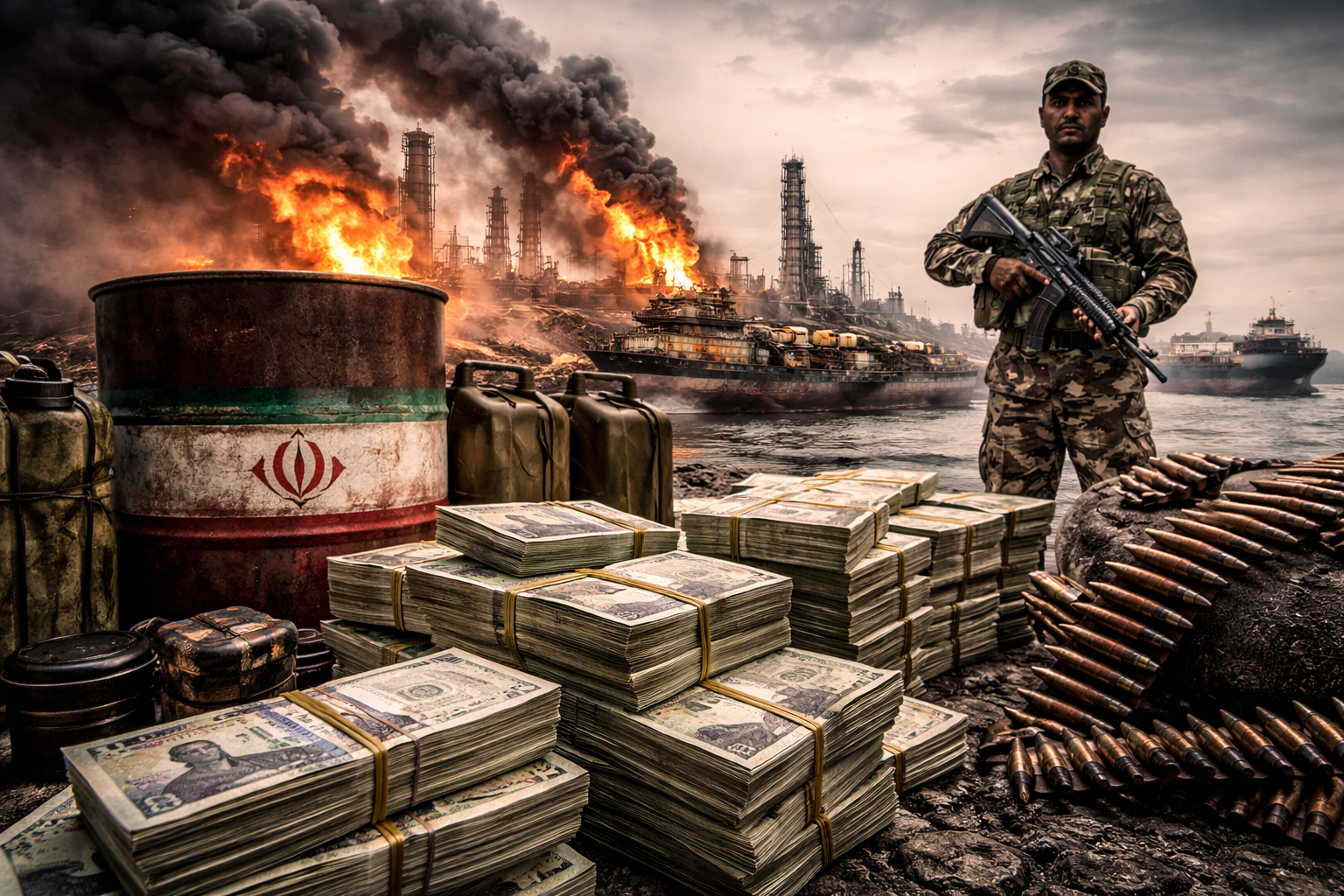
Most coverage of the Iran war focuses on missiles, military targets, and body counts.
Yet the more relevant question—one that few are asking properly—is this: how does a country with 48% inflation, a currency that has lost 99% of its value in a decade, and daily rolling blackouts still manage to keep a war running?
The answer reveals much about where this conflict heads next—and what it means for global energy markets.
Iran’s economic collapse did not begin on 28 February 2026.
By the time the US and Israel launched their first strikes, the country was already mired in what the IMF and World Bank had independently described as the worst economic period in its modern history.
GDP had fallen from roughly $600 billion in 2010 to an estimated $356 billion by 2025.
The rial crossed 1,000,000 to the US dollar in March 2025, making it, at that point, the least valuable currency on earth. Inflation reached 48.6% in October 2025.
The World Bank projected GDP to shrink a further 1.7% in 2025 and 2.8% in 2026, with around three million more Iranians expected to fall below the poverty line by 2027.
The Ministry of Social Welfare had already acknowledged that 57% of Iranians were experiencing some form of malnutrition.
Half of the country’s industrial capacity lay idle—not due to damage from air strikes, but because of rolling blackouts lasting three to four hours daily since early 2025.
The bitter irony is that Iran holds roughly 10% of the world’s proven oil reserves and 15% of its gas.
The energy crisis was never about resources, but about governance and investment failure—compounded by decades of sanctions, corruption, and a leadership that kept promising a “resistance economy” without ever creating one.
Iran’s import bill reached $72 billion in the fiscal year ending March 2025—a 65% rise from 2017, the last full year of meaningful sanctions relief.
Firms hoarded inventory as an inflation hedge by converting foreign exchange into goods, making it increasingly difficult for the central bank to defend the rial and triggering a vicious cycle it could not escape.
Where does the war money come from?
The Islamic Revolutionary Guard Corps (IRGC) controls around half of Iran’s oil export revenue.
That figure is central to understanding why the civilian economy and the war machine now operate as two separate systems. One is collapsing; the other is not.
Iran’s oil continues to flow to China.
Since the strikes began on 28 February, an estimated 11.7 million barrels of Iranian crude reached Chinese refineries by 15 March, according to tanker-tracking data.
All were settled outside the US dollar system through shadow fleet vessels—transponders disabled, flags altered, and GPS spoofed.
China’s independent “teapot” refineries handle most of this crude via a network largely insulated from international banking channels.
The $8–$10 per barrel discount gives Beijing a clear commercial incentive to keep the arrangement running even as it publicly calls for de-escalation.
Beijing’s 25-year, $400 billion cooperation agreement with Tehran, signed in 2021, covers energy, banking, and infrastructure. That investment does not vanish overnight.
While China will not overtly back Iran militarily, it has a strong interest in ensuring Tehran remains sufficiently functional to continue supplying discounted crude.
The Strait of Hormuz: Iran’s real financial weapon
Current reporting on the Hormuz crisis tends to frame it as a purely military or shipping issue. In truth, it is also a sophisticated financial instrument.
In the first half of March 2026, only 77 ships transited the Strait—down from 1,229 a year earlier, a 94% collapse in traffic.
The International Group of P&I Clubs, which insures 90% of the world’s ocean-going tonnage, withdrew cover for vessels passing through the Strait.
When marine insurance disappears, the dollar-denominated shipping system does not just become more expensive—it fragments.
Crucially, Iran has not closed the Strait to itself. Its oil still flows to China through these waters.
What Tehran has done is make the rules of passage uncertain for everyone else—an ambiguity almost as economically disruptive as a full blockade.
Brent crude surged about 15% in the opening days of the war, hitting $120 per barrel as the conflict deepened.
The WTO estimates that if elevated energy prices persist through 2026, they could trim global GDP growth by 0.3 percentage points.
European gas benchmarks have nearly doubled, prompting the ECB to postpone planned rate cuts. UK inflation, meanwhile, is now expected to breach 5%.
Iran is internalising military inferiority while externalising economic pain.
Unable to match the US and Israel militarily, it is instead making the war expensive enough for others that the pressure for negotiation builds externally.
What the regime can and cannot absorb?
The Islamic Republic has outlasted dire domestic conditions before, but this time the convergence of stress factors is unprecedented.
Protests that began on 28 December 2025 have spread to all 31 provinces. Earlier waves of unrest in 2019 and 2022 were contained through internet blackouts and heavy-handed crackdowns.
Those tactics are being used again, but the scale and persistence of the current protests suggest something deeper and more systemic.
The regime’s enduring wager is that the IRGC’s loyalty can be secured financially, even as the civilian population bears the hardship.
That calculation holds as long as shadow oil revenues continue to flow.
Washington has tried to tighten enforcement through secondary sanctions on Chinese entities, tanker seizures under Operation Southern Spear, and pressure on flag registries and insurers.
Tanker-tracking data show Chinese imports of Iranian crude averaging roughly 1.38 million barrels per day in 2025, falling slightly to around 1.13–1.20 million barrels per day in January and February 2026.
The decline is minor but significant—it shows pressure at the margins, though the lifeline remains largely intact.
Three scenarios, one variable
For investors analysing energy markets, Gulf sovereign credit, or emerging-market risk, one variable will decide the trajectory: whether the US succeeds in decisively disrupting the China–Iran oil corridor.
If it does, the IRGC’s parallel economy starts to fracture, bringing forward either regime collapse or a negotiated off-ramp.
If it does not, Iran can sustain its Hormuz pressure campaign for months, keeping European energy markets under strain through the summer refill season and further complicating the ECB’s already delicate policy path.
US Treasury Secretary Scott Bessent signalled in mid-March 2026 that Washington might consider easing sanctions on some Iranian oil to relieve global energy pressures.
That remark alone shows the leverage is working both ways.
Iran’s power lies not in military strength but in its willingness to burn—economically and politically—alongside its adversaries. The only question is who blinks first at the cost of that fire.
The post How does Iran keep its war machine running amid 48% inflation? appeared first on Invezz