
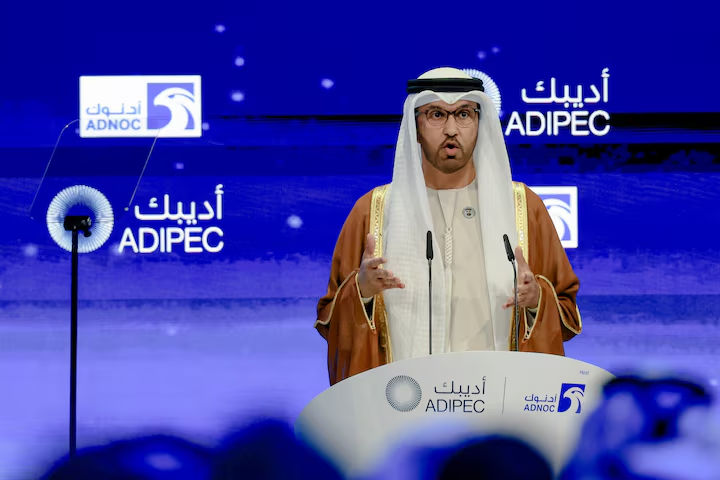
The chief executive of Abu Dhabi National Oil Company has called for the immediate reopening of the Strait of Hormuz, warning that ongoing restrictions are disrupting global energy markets.
Speaking on Thursday, Sultan Al Jaber stated that Iran must restore access to the vital shipping route and be held accountable for the damage caused by recent attacks on infrastructure.
In a LinkedIn post, Jaber said the Strait effectively closed since the onset of the US-Israeli conflict with Iran on February 28 remains inaccessible, with passage tightly controlled.
He emphasised that the situation has created significant uncertainty for global oil flows.
“Iran has made clear through both its statements and actions that passage is subject to permission, conditions, and political leverage.
That is not freedom of navigation. That is coercion,” Jaber wrote.
Energy security at risk amid ongoing disruptions
Jaber stressed that unrestricted access to the strait is critical for maintaining global energy stability.
He warned that continued disruptions are already delaying supply, tightening markets, and driving up prices.
He further noted that approximately 230 oil tankers are currently loaded and ready to depart, but remain unable to proceed due to restrictions.
“That is how we slow the economic shockwave already moving through the system,” Jaber added.
Despite the challenges, ADNOC has continued to operate within constraints.
Regional energy infrastructure under attack
The disruption comes amid broader instability in the region, with energy facilities reportedly targeted in neighbouring countries including Saudi Arabia, Qatar, Kuwait, and Bahrain.
Jaber reiterated the UAE’s stance that Iran should be held responsible for the damage caused by attacks on civilian and energy infrastructure.
“The UAE has reiterated its position that following the substantial and illegal attacks on UAE civil and energy infrastructure, Iran must be held accountable and fully liable for damages and reparations,” he said.
Production impact and economic implications
According to a mid-March report by Reuters, the UAE’s oil production dropped by more than half following the effective closure of the strait.
The disruption forced ADNOC to implement widespread production shut-ins.
As a key contributor to the UAE’s economy and a major producer within OPEC, ADNOC plays a central role in global oil supply, with the country previously accounting for around 4% of global output.
However, despite reduced production, a Reuters analysis suggested that ADNOC’s revenues in March remained broadly stable compared to the previous year.
Higher oil prices helped offset lower output, while the company also utilised alternative export routes to sustain shipments.
Jaber, who also serves as the UAE’s minister of industry and advanced technology and special envoy for climate change, has led ADNOC for a decade.
During his tenure, he has overseen a major modernisation drive, raising billions in investment and aligning the company with global energy strategies.
He also served as president of the COP28 climate summit held in Dubai in 2023, reflecting his dual role in both traditional energy and climate policy.
As tensions continue to disrupt one of the world’s most critical oil transit routes, Jaber’s remarks underscore the growing urgency for a resolution to restore stability in global energy markets.
The post Strait of Hormuz closure sparks concern, ADNOC CEO calls for action appeared first on Invezz